


Sep 11,2026
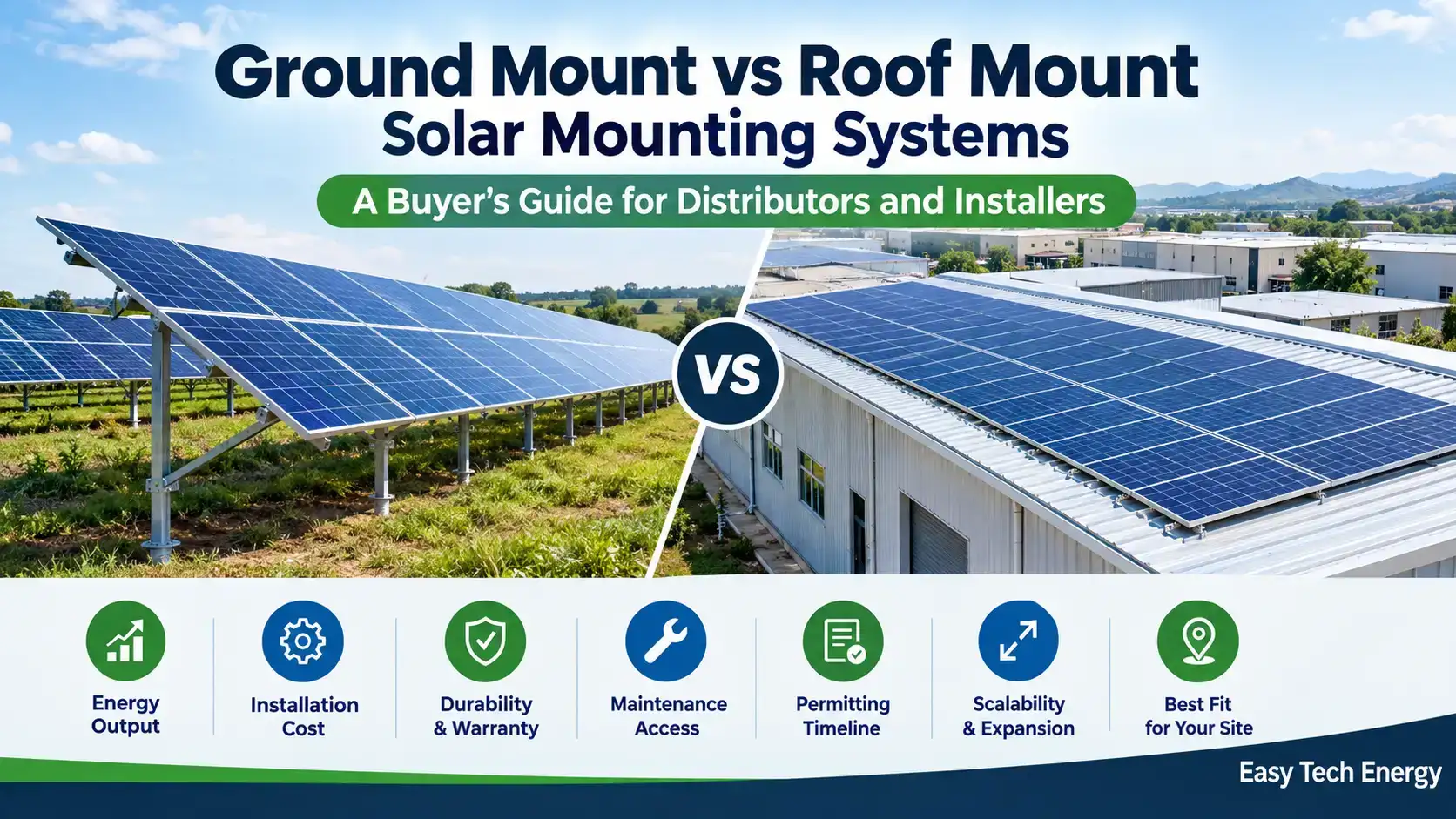
Every solar project needs a Solar Mounting System. The structure holds the panels in place, and it directly affects energy output, installation cost, and long-term durability. Distributors and installers usually choose between two main types: ground mount systems and roof mount systems.
This guide compares both options. It explains where each system performs best, and it helps you match the right structure to your customer's site conditions. It also covers what to check before you place a bulk order.
A ground mount system holds solar panels on a rack that stands directly on the ground. The rack connects to the earth through steel piles, ground screws, or concrete piers. Installers use ground mounts for open fields, farms, commercial yards, and any site where roof space is limited or unavailable.
A ground mount system gives the installer full control over the tilt angle and the direction of the array. This control increases energy output over the life of the system.
A roof mount system attaches directly to an existing roof structure. The racking bolts into the roof rafters or purlins, and it uses the building itself as the foundation. Roof mounts work well for warehouses, factories, and any property with strong, unshaded roof space.
A roof mount system costs less to install because it skips the foundation work that a ground mount requires.
Higher energy output. A ground mount system reaches the optimal tilt angle for its location. Installers can set the angle anywhere from 5 degrees to 60 degrees, depending on the site and the customer's latitude. This flexibility increases the annual energy yield compared to a fixed roof pitch.
Better airflow and cooling. Ground-mounted panels sit above open ground, and air moves freely underneath them. Cooler panels produce more power, because solar panel output drops as panel temperature rises.
Easier access for maintenance. Technicians reach ground-mounted panels without a ladder. This lowers the labor cost of cleaning, inspection, and repair over the system's lifetime.
Simple expansion. A ground mount array can grow as the customer's energy needs grow. The installer adds new rows to the existing foundation, and the array keeps a uniform orientation.
Fits large-scale and agricultural projects. Ground mounts support commercial-scale and agrivoltaic projects that a roof simply cannot host. Farms use ground mounts with 30 to 72 cell panel compatibility, dual-use racking, and auger pile or concrete footing options.
A ground mount system needs more upfront material and labor. The installer digs foundations, sets piles or screws, and runs trenching for the electrical conduit. This adds cost compared to a roof mount.
Permitting also takes longer in many regions, because local authorities treat a ground mount as a new structure on the property. The installer should confirm setback rules and soil conditions before finalizing the design.
A ground mount uses land that the property owner might want for other purposes. This matters most on smaller commercial plots.
Lower installation cost. A roof mount uses the existing building structure. This removes the need for foundation work, and it usually cuts total project cost by a meaningful margin compared to a ground mount.
Faster permitting. Most jurisdictions treat roof mount installations as a standard accessory use. This shortens the approval timeline compared to ground mount permitting.
No land use conflict. A roof mount frees up the ground for parking, storage, or other business operations. This makes roof mounts a strong fit for warehouses, factories, and urban commercial sites.
Roof orientation limits energy output. A roof faces one fixed direction, and the installer cannot change the building's angle to the sun. East-facing or west-facing roofs produce less energy than a properly oriented ground mount.
Roof condition also matters. An aging roof may need repair or replacement before installation, and removing panels for future roof work adds cost. The installer should confirm the roof's remaining lifespan and load-bearing capacity before quoting the project.
Maintenance takes more effort on a roof. Technicians need ladders and safety equipment to clean panels or troubleshoot issues.
| Factor | Ground Mount | Roof Mount |
|---|---|---|
| Installation cost | Higher | Lower |
| Energy output | Higher (optimal tilt and airflow) | Depends on roof pitch and direction |
| Maintenance access | Easy, ground level | Requires ladder and safety gear |
| Permitting timeline | Longer | Shorter |
| Land use | Uses open land | Uses existing roof space |
| Expansion | Simple | Limited by roof size |
| Best fit | Farms, commercial yards, open sites | Warehouses, factories, buildings with strong roofs |
Ask three questions before you recommend a mounting type.
Does the site have open, unshaded land? If yes, a ground mount usually delivers better long-term output. If the site sits in a dense urban area with no open land, a roof mount becomes the practical choice.
What condition is the roof in? An older roof, or a roof with limited load capacity, pushes the decision toward a ground mount. A newer, structurally sound roof supports a roof mount without added risk.
What is the project timeline and budget? A roof mount moves faster through permitting and costs less upfront. A ground mount costs more at the start, but it can produce a stronger return over the system's full lifespan, especially on agricultural and commercial-scale projects.
Distributors and installers need a mounting system supplier that delivers consistent quality across every shipment. Easy Tech Energy manufactures both ground mount and specialized agricultural mounting systems using high-strength aluminum alloy AL6005-T5 and stainless steel SUS304. Every system carries a 10-year warranty, and the racking withstands wind speeds up to 45 m/s and snow loads up to 1.5 KN/m².
Our ground mounting system handles wide project spaces and large-scale installations. Our agricultural solar mounting system supports dual-use agrivoltaic layouts with an adjustable tilt range from 5 degrees to 60 degrees.
Contact our team today to request bulk pricing and technical specifications for your next project.


Powered ByTradeWheel.com